

Problems
The only payment credential most of your users have is a card, and nothing about a card was designed to be handed to software that acts on its own:- The real card number ends up in the agent’s context. It travels through prompts, logs, tool calls, and model providers. Once leaked, it can be charged again and again. There is no limit the agent cannot exceed, no expiry, and no way to revoke without cancelling the card. It also drags the developer into PCI scope.
- Keeping a human in the loop defeats the purpose. Approving every payment is safe, but the user is interrupted at the exact moment the agent was supposed to save them time.
- Prepaid or virtual cards from a fintech give up the user’s card. The user funds a new balance instead of using the card they already have, loses their rewards, refunds, and chargeback protections, and the developer often becomes the account holder for money that is not theirs.
- Custodial agent wallets create custody and trust problems. Someone other than the user controls the funds, which raises licensing questions and still gives the agent unlimited access to whatever is in the wallet.
- A card vault with a browser proxy leaves the checkout to you, and does not work at every merchant. The proxy sits between the browser and the merchant, and puts the real card number into the network traffic, so the agent does not see it. But you run the browser and the agent yourself, and you keep a token for each session, a proxy with a trusted certificate, and a list of card-entry hostnames for each merchant. Some merchants protect card details end to end: their payment form encrypts the card in the browser, or their payment provider checks that no one intercepts the connection. The proxy cannot work there. The merchant also gets the real card number, and the token has no spending limit.
- Limits enforced only in application code do not hold. They stop honest mistakes, not a compromised agent, a manipulated model, or a leaked credential.
Solutions
Crossmint gives agents two payment instruments. Both follow the same principle: the user delegates a bounded allowance, the bound is enforced outside the agent, and the user can revoke it at any time.Agent Cards
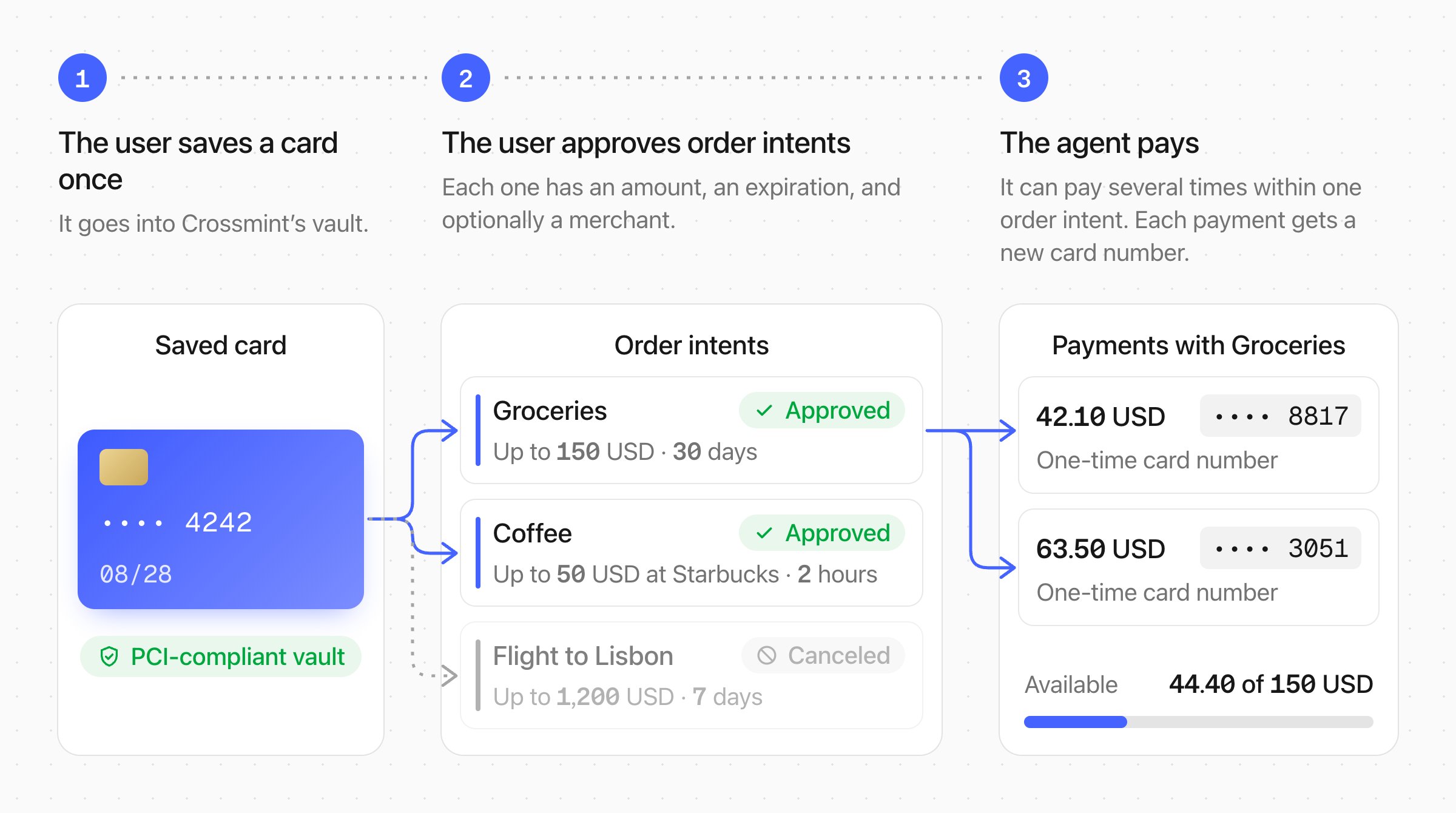
Read Card Rails and PCI Compliance for the card data path, and the Agent Cards overview for the product.
Agent Wallets
For machine-to-machine payments, cards do not always fit. Paying an API per call or settling with another agent often involves amounts too small and too frequent for card fees and chargeback rules. These payments usually run on stablecoins, but MPP also accepts cards. The user owns a non-custodial wallet and adds the agent as a signer with a scoped permission set: a spend cap, allowed counterparties, and a time window. The permissions are enforced onchain, so a transaction outside them is rejected at the wallet level, and the user can revoke the signer at any time. Neither you nor Crossmint takes custody. Read the Agent Wallets overview for the product.Every delegation is explicit, scoped, enforced outside the agent, and revocable. The agent gets exactly the spending power the user granted, and nothing that survives a leak.
See Also
How Agents Buy
Why a secure card was not enough, and how one API buys from any merchant
Agent Cards
Save once, approve many, pay on the right rail
Agent Wallets
Scoped, non-custodial stablecoin wallets